Making a Streetwear Tech Pack is a fundamental part of the process for designers and brands who want to see their ideas professionally produced. A tech pack is like a very detailed plan that shows manufacturers all the specifications of the garment, and this way, the designs can be made accurately and efficiently. In clothing manufacturing, the right tech pack not only avoids errors when making samples but also ensures materials are used effectively and uniformly across the production line. If you are creating a t-shirt techpack, a Hoodie Tech Pack, or a Sweatshirt Tech Pack, knowing how to make a streetwear tech pack is what will help you to grow your brand.
What is a Streetwear Tech Pack?
A Streetwear Tech Pack is a detailed set of files that contains all the technical and design information necessary for the production of streetwear clothes. It shows not only the patterns and measurements but also the sewing instructions, materials, trims, labels, and any other notes on the construction. A Streetwear Tech Pack can have different layers of hoodies, very large sweatshirts, graphics, various types of pockets, and other elements of streetwear fashion design that make it more complex than simple tech packs for t-shirts. A thorough clothing techpack is a kind of message that goes between the designer and the manufacturer so that the latter knows exactly what the former intends to produce.
Key Components of a Streetwear Tech Pack

Flat Sketches and Design Illustrations:
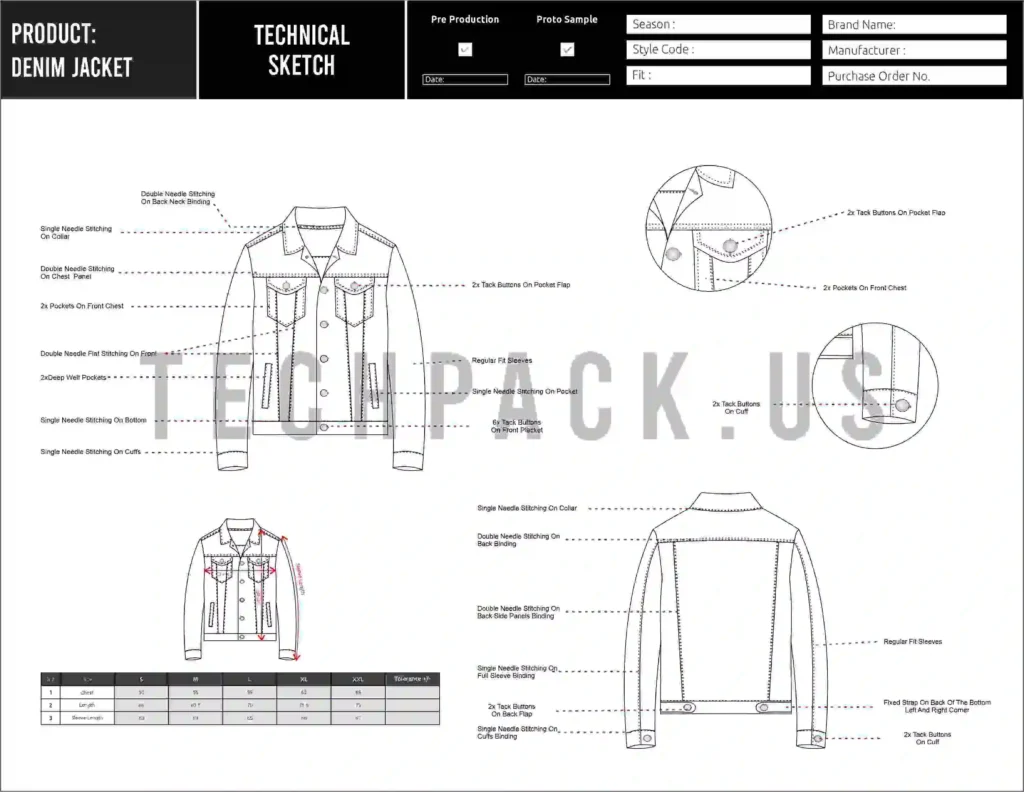
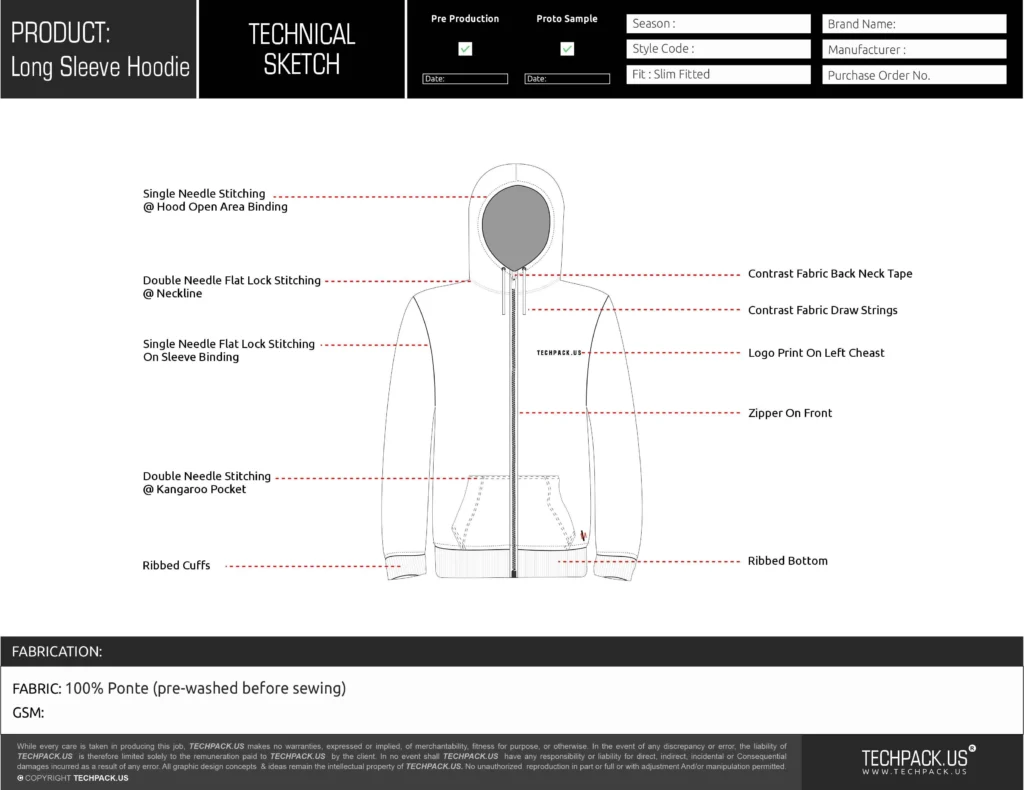
Flat sketches give a clear visual of the clothing from all sides: front, back, and side. These drawings show in detail seams, pockets, hoods, ribbing, and any other kind of ornamentation. For instance, in a Hoodie Tech Pack, sketches indicate the shape of the hood, kangaroo pocket placement, and zipper details, whereas a Sweatshirt Tech Pack puts an emphasis on sleeve and hem proportions.
Measurement Spec Sheets:
Accurate measurements are a very critical aspect in the production of garments. A tech pack sample includes all major points of contact, such as the width of the chest, length of the body, length of the sleeve, depth of the hood, and the slope of the shoulder. The grading standards for various sizes are also presented so that proportional accuracy is maintained from S, M, L to XL.
Pattern Information:
Patterns are the guide for the cutting of fabric pieces. When you add pattern information to your Streetwear Tech Pack, you are not leaving the factory guessing on how the different pieces are stitched together. This is equally true for t-shirts, hoodies, sweatshirts, and any other streetwear that is layered. You can add a digital or physical pattern sample to the tech pack for an exact execution.
Materials and Fabrics:
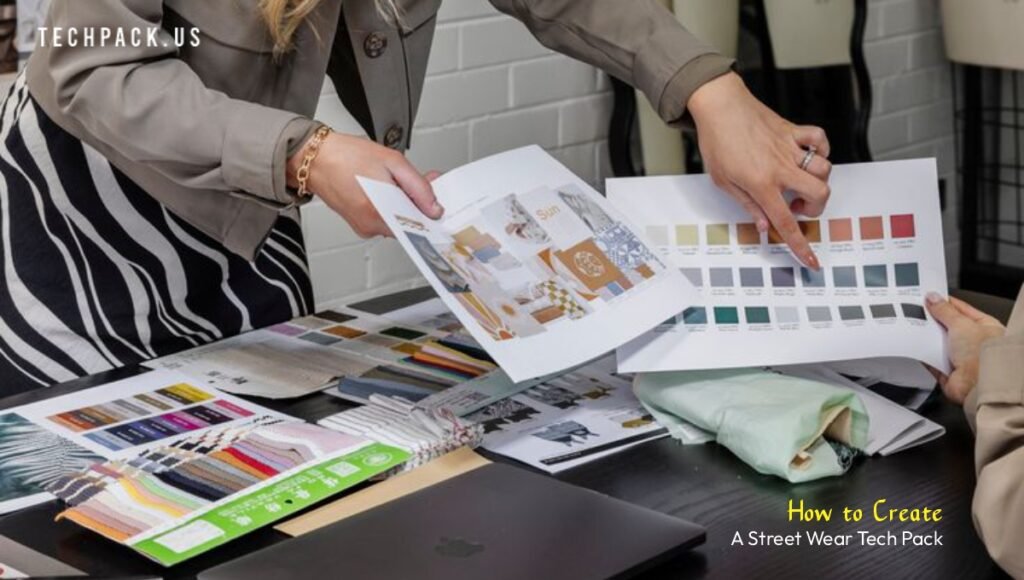
A comprehensive streetwear tech pack will pinpoint fabric type, weight, stretch, color, and information about the supplier. The choice of fabric determines the drape, comfort, and wear resistance, especially in the cases of hoodies and oversized sweatshirts. By providing accurate fabric details, you are making sure that the manufacturers will get the materials that fit your design concept.
Trims and Accessories:
Items such as the zippers, drawstrings, buttons, and eyelets that complete the look are mentioned in the tech pack. In the case of a zipped hoodie, you should have the length of the zipper, the type, and the gauge. In the case of pull-over hoodies or sweatshirts, you have to indicate the length of the drawstring, the size of the eyelet, and the location. Having the correct trim details will lessen the chances of mistakes during the assembly phase.
Construction and Sewing Details:
Construction notes will tell you the kind of seams, the length of stitches, the points that need reinforcement, and the procedures to be used for finishing. All these written directions are indispensable if one intends to keep up the standard and make sure a garment is long-lasting. A Streetwear Tech Pack is the manufacturer’s guide to the designer’s plan, whether the product is casual t-shirts or hoodies and sweatshirts for layering.
Branding and Label Placement:
Labels, prints, patches, and embroidery placements are all clearly indicated on the tech pack. For streetwear, logo placement is a key issue because it greatly affects the visual appeal and brand identity. The tech pack example should have measurements and positioning instructions that would prevent misalignment in the production process.
Packaging and Care Instructions:
The tech pack must give the details of packaging requirements, hang tags, and care instructions as well. That is how the end-product will be delivered in perfect condition to the customer, and at the same time, the consistency of all units is maintained.
Steps to Create a Streetwear Tech Pack
Step 1: Conceptualize Your Design
Start by putting down your streetwear concept on paper with sketches or mood boards. Pick a garment style—maybe that’s a t-shirt techpack, hoodie, sweatshirt, or a layered streetwear piece. Figure out what makes your design stand out. Are they oversized silhouettes, graphics, embroidery, or pocket variations?
Step 2: Develop Patterns
Draft the patterns for each part of the garment. If it’s going to be a hooded sweatshirt, that will probably be hoods, sleeves, pockets, and ribbing. For t-shirts and sweatshirts, it means patterns for the front, back, sleeves, and neckline. Developing correct patterns is very important for good fitting and saving production time. Put the patterns in your tech pack for the manufacturer’s better understanding.
Step 3: Create Flat Sketches and Technical Drawings
Make precise flat sketches that depict every side of the garment, along with seams, stitching, and design elements. Add writing on all technical details, including seam allowances, stitch types, and the method for attaching a hood. Flat sketches are like the visuals in a clothing techpack.
Step 4: Compile Measurement Specifications
Put down all the necessary measurements on a spec sheet, and don’t forget grading for different sizes. Length of the body, width of the chest, length of sleeve, depth of hood, widths of ribbing, and dimensions of pockets are the types of measurements you need to include. Proper documentation of the measurements is the surest way of keeping consistency in clothes manufacturing.
Step 5: Detail Materials and Trims
Draw up a list of all the fibres, weights, finishes, and trims in the garment, with the inclusion of suppliers or fabric codes if necessary. For streetwear hoodies and sweatshirts, point out ribbed cuffs, drawstrings, zipper types, and any custom embellishments.
Step 6: Document Construction Notes
Add sewing instructions, reinforcement points, and finishing techniques. Tell exactly how parts are to be put together through the use of the different types of stitching, seam allowances, and any special treatments. This leads to a decrease in manufacturing errors and sampling revisions.
Step 7: Add Branding Details
The tech pack should include label placements, embroidery, patches, or prints. Be clear about the dimensions, locations, and methods so that the brand is consistent. Streetwear frequently relies on visible logos and graphics; thus, accurate documentation is essential.
Step 8: Include Packaging and Care Information
Hang tags, folding instructions, polybag requirements, and care instructions should be laid out in a document. Packing is one of the details that makes the customers’ shopping experience delightful, as well as ensures that the garments are delivered in good condition.
Step 9: Review and Finalize Tech Pack
Look through the tech pack to make sure that everything is there. Apart from including the fabrics, flat sketches, and measurements, you should also include the materials, trims, construction notes, branding, and packaging. A completed tech pack example is a manufacturer’s handy guide during clothes manufacturing.
Benefits of a Streetwear Tech Pack
- Accurate Communication with Manufacturers:
A detailed tech pack gets rid of manufacturers’ doubts and thus leads to lower production errors. - Cost Efficiency:
Having patterns, materials, and construction details allows brands to reduce the amount of fabric wasted and the number of unnecessary revisions. - Time-Saving:
The well-grounded documentation not only decreases the number of sampling cycles but also speeds up production timelines. - Consistency Across Sizes and Styles:
Grading rules and patterns guarantee that the fit and quality are consistent in every unit, whether it is a different size or style. - Scalability:
Having a very good and documented Streetwear Tech Pack allows the brand to produce large quantities without sacrificing the standards of manufacturing.
Common Mistakes to Avoid
- Incomplete measurements and missing information about grading.
- Patterns that are not clearly defined result in different garment fits without consistency.
- Leaving out construction notes or stitch details.
- Not clearly specifying trims or fabric finishing.
- Being careless with branding placement accuracy.
By avoiding these common mistakes, you will be able to communicate effectively with manufacturers, and there will be fewer production errors, leading to large expenses.
Digital Tools for Creating a Streetwear Tech Pack
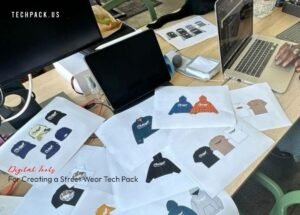
Employing digital tools such as CAD for pattern making as well as tech pack generation significantly quickens the process. Designers gain the ability to simulate fits, carry out pattern matching tests, and produce detailed tech packs for their manufacturers. The incorporation of digital patterns into a Hoodie Tech Pack, Sweatshirt Tech Pack, or t-shirt techpack allows for greater precision and faster production.
Conclusion
Putting together a streetwear tech pack is a matter of being meticulous, having technical documentation that is very clear, and making pattern development accurate. No matter if it is a t-shirt techpack, hoodie, or sweatshirt you are designing, a complete tech pack will be the guarantee that your streetwear designs will be made into real garments without any deviation from your concepts. For brands that intend to grow in an organized manner, it is very wise to invest effort in making professional streetwear tech packs because they minimize sampling mistakes, keep the quality at the desired level, and speed up the time to market.
We at techpack.us are experts in the creation of highly detailed clothing techpacks, Hoodie Tech Pack, Sweatshirt Tech Pack, and t-shirt techpack solutions that greatly facilitate clothes manufacturing and give brands a chance to make their streetwear ideas come true.
FAQs
What is a Streetwear Tech Pack?
A streetwear tech pack constitutes an assortment of documents that outline patterns, measurements, materials, trims, construction, branding, and packaging in detail for the production of streetwear.
Why is a tech pack important for clothes manufacturing?
A tech pack is a document that contains all the necessary detailed information for manufacturers to produce garments accurately, thus minimizing the possibility of errors, diminishing waste, and cutting down the duration of production.
Can a Streetwear Tech Pack include hoodies and sweatshirts?
Yes, the details for making hoodies and sweatshirts, as well as the other pieces of streetwear like t-shirts, can be included.
What should be included in a tech pack example?
A tech pack example will commonly comprise the following: flat sketches, measurement specs, pattern files, materials, trims, construction notes, branding, and packaging instructions.
Does techpack.us provide Streetwear Tech Pack services?
Yes, techpack.us is a company that is well-versed in producing not only professional Streetwear Tech Pack but also Hoodie Tech Pack, Sweatshirt Tech Pack, and t-shirt techpack that combined, can guarantee smooth production.