
In the world of fashion generation, accuracy is everything. From drawing your design to seeing it come alive on the retail rack, there are endless steps—and any communication error can result in expensive mistakes. This is where a POM for clothing comes in. POM, short for “Points of Measure,” is a foundational component in every clothing tech pack, helping brands ensure precision, consistency, and quality throughout the generation process.
Whether you’re creating a Hoodie Tech Pack, sweatshirt tech pack, t-shirt tech pack, or any other attire thing, your POM sheet is one of the most basic parts of the bundle. In this blog, we’ll break down what POM means, why it things, how to construct one accurately, and how it fits into the broader system of your clothing tech pack.
What is POM for Clothing?
POM stands for Point of Measure—a detailed list of all estimations required for a garment. Each point alludes to a specific area on the item of clothing (e.g., chest width, sleeve length, neck opening), and for each, the correct estimation is indicated for each size (S, M, L, XL, etc.).
The POM sheet is utilized by technical originators, pattern creators, and manufacturers to guarantee that each piece of clothing matches the designer’s deliberate and fits inside the brand’s measuring measures.
Why Is a POM Sheet Important in a Clothing Tech Pack?
Your clothing tech pack is the outline for your design. It communicates your imaginative vision in specialized terms, making it justifiable to factories, seamstresses, and quality control groups. The POM sheet is what deciphers your tasteful design into a real-world piece of clothing.
Here’s why it’s crucial:
- Ensures Fit Consistency: With correct estimations, you avoid undesirable shocks like a hoodie being too tight or a t-shirt fitting awkwardly.
- Reduces Sampling Errors: POM helps factories make exact prototypes from the beginning.
- Saves Time and Costs: Exact estimations decrease the require for excessive corrections and resampling.
- Supports Scaled Measuring: POM makes it simple to characterize how a design ought to scale over sizes.
How POM Differs by Garment Type

Each garment type requires a tailored approach to POM due to its unique structure and fit requirements. Here’s how POM plays out in common garments:
Hoodie Tech Pack
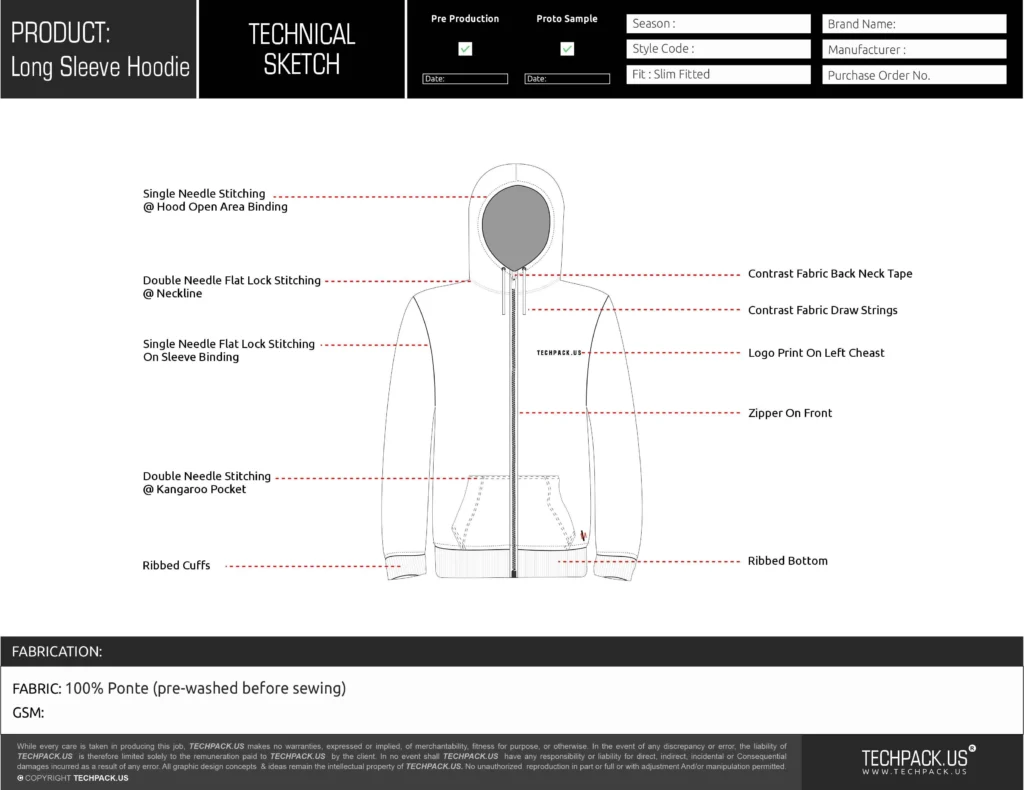
A Hoodie Tech Pack includes POMs such as:
- Chest Width (1” below the armhole)
- Body Length from HPS (High Point Shoulder)
- Sleeve Length from CB (Center Back)
- Hood Height and Width
- Rib Hem Width
Hoodies often involve extra details like lining, pockets, and ribbed cuffs—so your POM needs to cover these elements with precision.
Sweatshirt Tech Pack
Though similar to hoodies, a sweatshirt tech pack typically doesn’t include a hood. However, ribbed cuffs, hem bands, and neckline details are critical. Common POMs:
- Shoulder Width
- Chest and Waist Width
- Neck Drop (front and back)
- Armhole Depth
- Sleeve Opening Width
Because sweatshirts are often part of loungewear collections, accurate POM ensures comfort and consistency.
T-Shirt Tech Pack
A t-shirt tech pack may seem simpler, but precision is still key. Common POMs include:
- Chest Width
- Body Length
- Sleeve Length
- Neck Width and Depth
- Shoulder to Shoulder
For fitted or oversized tees, slight deviations in POM can drastically change the fit and overall look of the garment.
How to Create an Effective POM Sheet?
Creating a detailed, easy-to-follow POM sheet involves careful planning and accuracy. Here’s a step-by-step guide:

-
Start with a Measurement Chart
Include all the sizes (XS–XXL or your brand’s scale) in columns and each point of measurement in rows.
| POM Description | XS | S | M | L | XL |
| Chest Width (1” below armhole) | 18″ | 19″ | 20″ | 21″ | 22″ |
| Body Length from HPS | 26″ | 27″ | 28″ | 29″ | 30″ |
| Sleeve Length from CB | 31″ | 32″ | 33″ | 34″ | 35″ |
-
Provide Clear Diagrams
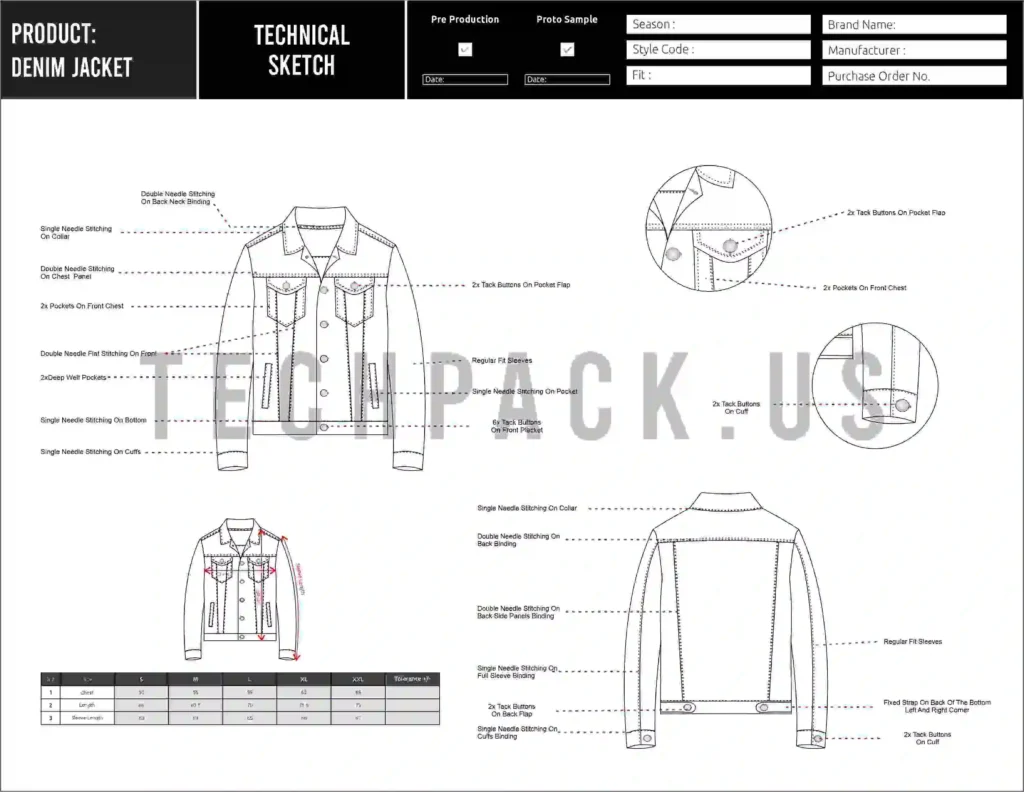
Add a garment flat sketch and use lines with labeled arrows to show exactly where each measurement is taken.
-
Add Tolerances
Tolerances define the acceptable margin of error for each measurement. For example:
- Chest Width: 20″ ± 0.5″
- Sleeve Length: 33″ ± 0.25″
This gives factories a range within which measurements are considered acceptable, avoiding unnecessary rejections.
-
Be Consistent in Terminology
Use the same terminology throughout your clothing tech pack—from spec sheets to construction notes.
Best Practices When Using POMs in a Clothing Tech Pack
- Review Factory Samples Carefully: Always double-check initial samples against your POM chart.
- Use Industry-Standard Measuring Points: Factories may interpret custom measurement names differently.
- Update After Fittings: Post-fit session, revise your POMs and redistribute the updated tech pack to your production partners.
- Save Version History: Keep track of all changes made to the POM sheet for accountability.
Common Mistakes to Avoid
- Leaving Out Key POMs: Don’t forget small but critical points like neck width or armhole depth.
- Using Vague Measurement Descriptions: “Sleeve Length” could mean from the shoulder seam or the center back—clarify it.
- Overly Tight Tolerances: Being too rigid can lead to production delays and waste.
How a Clothing Tech Pack Ties It All Together?

Your clothing tech pack acts like a user manual for your garment. It includes:
- Flat Sketches
- BOM (Bill of Materials)
- Construction Notes
- Stitching Details
- Fabric and Trim Specs
- Colorways
- Grading Rules
- And of course, the POM sheet
Together, these elements ensure that your design vision gets translated perfectly, from your sketchbook to your customer’s closet.
Final Thoughts: POM for Clothing
In today’s fast-paced fashion industry, where speed-to-market, quality affirmation, and brand keenness are more critical than ever, having a strong POM for clothing is a vital necessity—not fair a specialized prerequisite. It’s simple to get clear in the aesthetics of your plan, but it’s the specialized exactness that guarantees your pieces of clothing are really wearable, versatile, and manufacturable.
Think of your POM sheet as the glue that holds your entire clothing tech pack together. Whereas outlines and temperament sheets capture your inventive pith, the POM translates that imagination into numbers—concrete, repeatable benchmarks that industrial facilities over the world can follow. Without a well-constructed POM, indeed, the most wonderful hoodie or t-shirt design can drop level due to poor fit, conflicting measurements, or miscommunication amid production.
Moreover, incorporating POMs over all garment types—whether it’s a Hoodie Tech Pack, sweatshirt tech pack, or t-shirt tech pack—not as it were guarantees a steady fit but moreover builds believe with your customers. When your measuring remains reliable over collections, it decreases returns, boosts brand devotion, and upgrades your overall brand picture. It’s a detail that consumers may never see specifically, but they completely feel the distinction when they wear your product.
POMs are moreover important for scaling your brand. As your generation extends to multiple production lines or countries, your tech pack, driven by an exact POM sheet, guarantees consistency over diverse producers and generation runs. This standardization minimizes generation mistakes, keeps up brand fit, and keeps your operational costs under control.
Whether you’re a solo originator working on your to begin with line or a prepared brand scaling universally, taking the time to construct detailed, accurate POM sheets inside your clothing tech pack is an speculation that pays off exponentially. It engages your generation accomplices, raises your last item, and secures your brand’s notoriety in a competitive marketplace.
So the next time you’re compiling a Hoodie Tech Pack, a sweatshirt tech pack, or a t-shirt tech pack, keep in mind: the excellence of your garment begins with imagination, but its victory closes with accuracy. And exactness begins with a strong, well-planned POM.
FAQs: POM for Clothing
What is the difference between a POM sheet and a spec sheet?
A POM sheet lists specific measurement points and values for each size. A spec sheet is broader—it may include measurements (POMs), materials, fit comments, tolerances, and more. The POM is a part of the spec sheet.
Can I use the same POM for Clothing different garments?
Not exactly. While some POMs (like chest width or body length) apply broadly, each garment—be it a hoodie, sweatshirt, or t-shirt—has unique design elements that require garment-specific measurements.
How do I know what tolerances to set?
Tolerances depend on the fabric type and the manufacturing method. Woven fabrics typically require tighter tolerances than knits. Consult with your technical designer or factory to determine what’s realistic.
How many POMs should be included?
That depends on the complexity of the garment. A simple t-shirt might have 8–10 points. A Hoodie Tech Pack may have 15 or more due to additional design elements like pockets and hoods.
Do factories always follow the POM sheet exactly?
Factories aim to stay within the tolerances listed. However, without a clear, well-documented POM sheet, there’s a higher risk of deviation. That’s why accurate documentation is essential.